

In a world where hot espresso reigns supreme, cold brew is quietly rewriting the rules of extraction – with no heat, no pressure, and no rush. To extract cold brew coffee, however, a different set of rules applies.
For years, these rules involved a lengthy brewing process, up to 24 hours in some cases. Without heat or pressure, time became the key variable to a proper brew. Nevertheless, technological advancement and engineering prowess have led to cold brew extraction in as little as 60 minutes.
Modern day consumers like to understand all they can about the food and beverages they choose to spend money on. Whether it’s the provenance of a coffee bean, the story of the grower or farm where the supply chain starts, or the specific techniques and tools used to pour a perfect cup, people want the details.
This article serves to peel back the curtain and expose the science of cold brew extraction. We interviewed Krzysztof Barabosz, head of coffee and co-founder of Hardtank, to get an expert look into how, at a fundamental level, it all works.

What exactly defines cold brew coffee?
Cold brew coffee differs significantly from both hot coffee and traditional ‘iced’ coffee drinks. The latter regularly features espresso shots as a base, rapidly cooled with ice before being served. Cold brew is cold from the moment the brewing starts. There is no last-minute dilution or snap chilling.
No heat means different flavour profiles. Cold brew is celebrated for its mellow profile, lighter body, and generally lower acidity. Unlike espresso or filter coffee, cold brew is rarely bitter unless it is over-extracted.
“Cold brew extraction is a method of extracting coffee using cold or room temperature water over an extended period – typically 12 to 24 hours,” says Krzysztof.
“Unlike traditional hot brewing, where high temperatures rapidly dissolve flavours, acids, and oils, cold brew instead relies on time in order to draw compounds from the coffee grounds. The result is a smoother, less acidic beverage with a different balance of flavours. Cold brews often highlight sweetness and body over sharpness or brightness.
“Because the chemistry of extraction changes dramatically with temperature, cold brew emphasises fundamentally different aspects of any coffee bean’s character.”
Krzysztof highlights some key differences between cold brew extraction and any other traditional brew. Cold brew’s perceived acidity is far lower because of the brewing process. Instead of the sharp, bright acidity that one might encounter in a light roast espresso, cold brew offers smooth, balanced sweetness.
A growing trend among younger consumers is a quest for more gut-friendly food and beverages. Cold brew is a popular choice thanks to the above factors. Lower acidity and more balanced profiles are seen to be easier on the stomach.
Moreover, brewing cold brew helps roasters stratify their portfolios. The same bean, extracted via an espresso machine or a cold brew machine, can result in markedly different tasting profiles.

If time is essential, then how do cold brew machines brew so quickly?
“Extraction is fundamentally a process of dissolving soluble compounds from ground coffee into water,” says Krzysztof.
“At lower temperatures, this process slows down significantly because molecular activity is reduced. Simply put, cold water doesn’t extract solubles as efficiently as hot water. To compensate, we increase the brewing time.
“The downside is that long steeping times introduce inconsistency and oxidation and increase the risk of microbial growth (especially at room temperature). From a business perspective, it’s not the most efficient method – it slows down production and limits your ability to meet demand.”
In summary, to produce a quality cup of coffee, a brewer needs to employ at least one of the three key variables: heat, pressure, or time. As cold brew forgoes the first two, extended time is essential, but it causes unhelpful bottlenecks.
Hardtank machines and other commercial cold brewers have found a way around this, however.
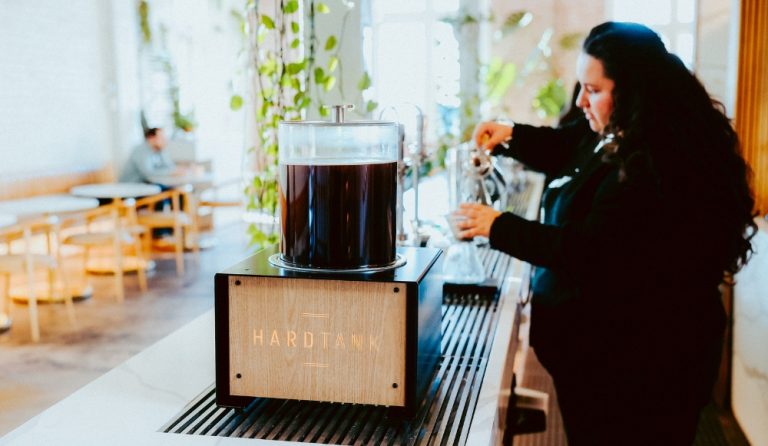
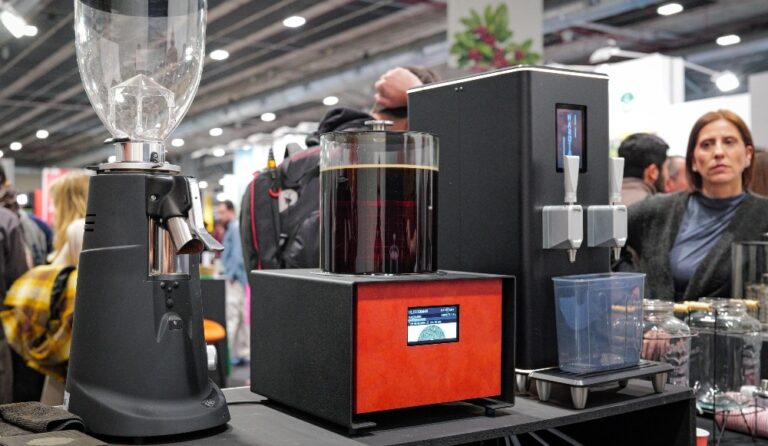
“Hardtank’s system is designed to overcome the limitations of traditional cold brew by introducing dynamic movement into the extraction process,” Krzysztof adds.
“Instead of relying on passive diffusion over many hours, Hardtank actively circulates the water through the coffee bed, significantly enhancing the contact between water and coffee particles. This increases the rate of mass transfer, allowing for a complete extraction in under an hour.
“However, what’s more important is that this faster method doesn’t compromise quality and, in fact, improves it. By controlling the amount of water and brewing time, we ensure a consistent and repeatable extraction process.”
Krzysztof describes a patented recirculation process that is key to Hardtank’s performance.
“The patented recirculation process integrates controlled agitation,” he says.
“Our system creates a gentle but continuous flow, ensuring all coffee particles are evenly exposed to water. This turbulence reduces the boundary layer – a layer of stagnant water around each coffee particle, which slows extraction. By keeping the grounds in motion, we shorten brewing time and improve flavour development.

What are the key variables in cold brew extraction?
Cold brew coffee machines leverage cutting-edge technology to brew high-quality cold brew quickly and consistently. These systems are designed to optimise the key variables at play in cold brewing.
We asked Krzysztof to shed more light on what is being managed so precisely.
“TDS, or total dissolved solids, is an important quality metric in coffee. It measures how much material has been extracted from the grounds into the final brew. For cold brew, a target TDS is typically between 1.4% and 1.8%, depending on the desired strength and profile. Our goal is to maximise desirable solubles – sugars, acids, oils – while avoiding over-extraction of bitter compounds.”
Cold brew extraction, like any extraction method, is vulnerable to multiple variables. The most important things to consider are:
- Water temperature: 4°C to 20°C is the ideal window. The lower the temperature, the cleaner and less acidic the cup.
- Water quality: Water mineral content affects both flavour and extraction efficiency, especially calcium and magnesium. Filtered water with moderate hardness is best.
- Roast profile: Medium to medium-dark roasts perform best, offering both sweetness and body. Nevertheless, even light roasts work well in Hardtank systems.
- Grind size: coarse grinds help prevent over-extraction and clogging. Hardtank machines fine-tune grind size to reduce uneven brewing. We recommend 450-500 microns.
- Storage conditions: minimising oxygen exposure during brewing is essential, and aseptic or chilled storage helps extend shelf life.
A recent study comparing Hardtank cold brew extraction to traditional methods revealed the following:
- 20% more chlorogenic acids, which are the key antioxidants associated with health benefits and balanced acidity
- 12% more caffeine, giving a more substantial stimulant effect per gram
- 4x more lipids, which play an essential role in mouthfeel and aromatic retention
The sensory profile of Hardtank-brewed cold brew more closely resembles hot brewed coffee, capturing brightness, body, and aroma without sacrificing that signature smoothness. Baristas and roasters can use this to significant effect, stratifying their portfolios and offering consumers a better and more diverse set of experiences.
Want to cut cold brew time by 95% without compromising quality? Discover how the Hardtank system transforms your workflow – visit our website or get in touch with us directly.
You can also watch a recording of our recent webinar, Preparing Cold Brew Safely, here.
Cold brew extraction