
In this article, you’ll learn:
- How Hardtank’s RTD production facility works
- How we formulate, package, and pasteurise your private label RTDs.
- Which other services we offer, from microbial compliance to packaging customisation
Private label ready-to-drink (RTD) products are a core part of our business at Hardtank. We’re constantly looking for new formulations, technologies, and processes to upgrade our service and deliver high-quality drinks tailored to your brand. As part of this, we’re pulling back the curtain to show you our RTD production facility and how our process works.
Based in Opole, Poland, Hardtank’s RTD production facility spans every step of the process, from formulation to production, canning, and customisation. If you’re ready to upgrade your RTD service with exciting drinks and cost-effective partnerships, we’re here to help.
To find out what goes on at Hardtank’s RTD production facility, the co-founder and Head of Sales at Hardtank, Maciej Duszak, took a tour. Read on for his insight into the process.
What happens at Hardtank’s RTD production facility?
Hardtank’s RTD production facility is where our private label cold brew, matcha, and functional drinks are manufactured.
“The core of our facility is Hardtank’s cold extraction technology, and the heart is a big Hardtank machine,” Maciej says. “Our industrial-size Hardtank is capable of producing over 2,000 litres of cold brew per batch, which takes about one hour.”
That said, our RTD production facility is suited to drinks other than cold brew, too. “It’s not just about coffee – you can extract tea, herbs, and dried or fresh fruit,” he explains. “Many natural ingredients are suitable for extraction with Hardtank.”
The industrial-sized Hardtank machine works similarly to our commercial equipment, the Baby Hardtank and Hardtank 20. “We have extraction baskets, into which you put ground coffee or tea leaves,” Maciej says. “Then, the extraction basket goes straight into the extraction chamber. In the case of our industrial Hardtank, there are three chambers instead of just one, all independently controlled.”
As with other Hardtank systems, extraction takes around one hour per batch. Before the drinks are filled into aluminium cans, however, they undergo post-processing.
“Next, we blend it with other ingredients if necessary and cool it down,” he explains. “They include oat milk, syrups, flavourings, or fresh fruit pulp – whatever comes to mind.” This is where you can customise your RTD formulation, adding ingredients to alter the drink’s flavour profile to your brief.
“It all happens in our storage and blending tanks,” Maciej says. “Each of those has a digitally controlled liquid level and temperature control, as well as a nitrogen blanket that reduces oxygen exposure in the tank.
“It also has a constant blending feature that assures maximum homogeneity of the drink from the first can to the very last,” he continues.
How does canning work for Hardtank’s RTDs?
Maciej explains that, unlike other RTD manufacturers, all of Hardtank’s drinks are packaged in aluminium cans – a process that also takes place at our facility.
“Aluminium cans are the most sustainable way of packaging your beverages,” he says. “They’re lightweight, easy to transport, and cool down faster than a glass bottle. In Europe, the recycling ratio of aluminium is over 90%.”
Equally, aluminium cans are the only RTD packaging format compatible with liquid nitrogen infusion, which gives our cold brew its creamy cascading effect every time you pour the drink into a glass.
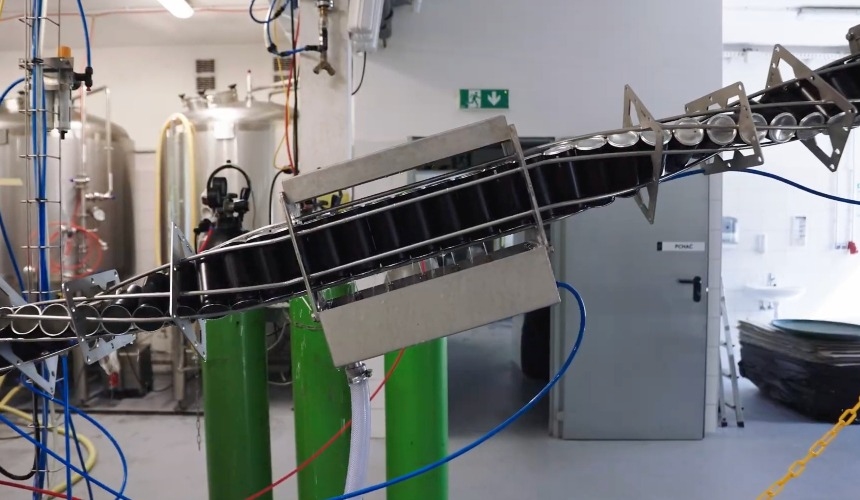
The actual process of canning at our RTD production facility requires several steps. “It starts with the depalletisation unit,” Maciej explains. “Here, we turn the cans upside down and rinse them with a cleaning agent to make sure they’re sanitised. Then, the cans are turned upright and flushed with nitrogen to remove oxygen from the cans.”
At this point, the cans are filled with your drink using automated filling heads. “Each filling head is equipped with a digitally controlled flow meter to ensure accuracy of ±1 ml,” Maciej says.
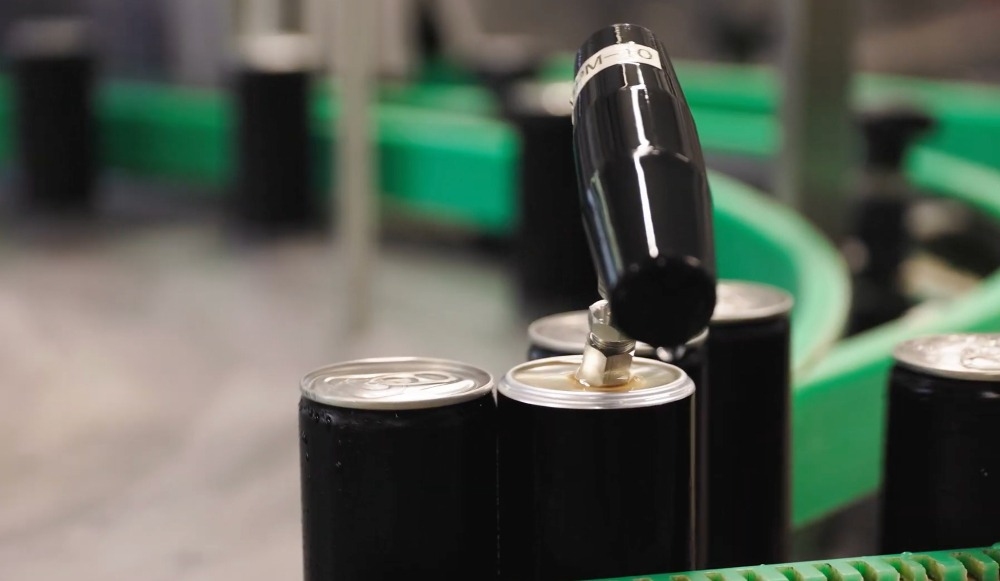
Once the cans are filled, we add liquid nitrogen before sealing. “It’s one of the final parts of the canning process – applying a drop of liquid nitrogen to each and every can, right before we apply the lid and seal each can.”
However, you can choose between nitrogen and carbonated drinks depending on your preference. “If you don’t want your drink infused with nitrogen because you prefer it fizzy, we can also carbonate it,” he says. You can also choose between can sizes of 200 ml or 250 ml, depending on your SKUs.
How Hardtank’s production facility ensures food safety and compliance
Another key aspect of Hardtank’s production facility is its compliance with food safety and hygiene regulations. When handled improperly, cold brew can be prone to microbial growth, and our systems are designed to minimise this risk with your RTDs.
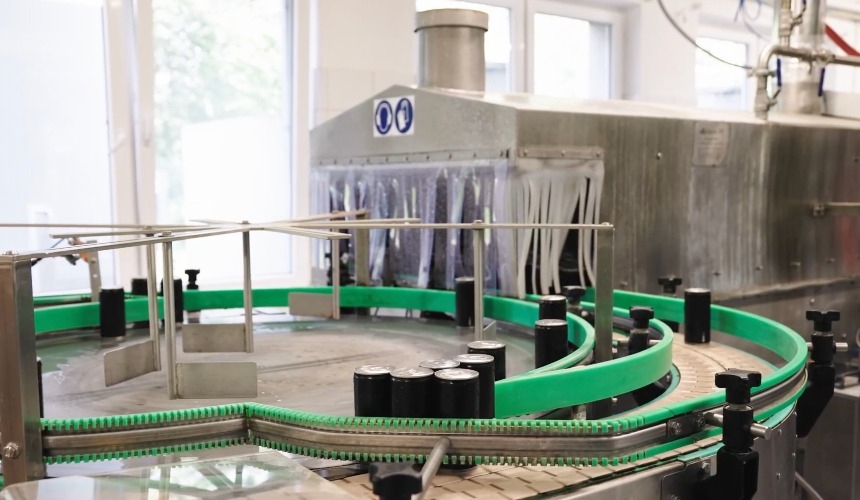
“Shelf life and safety are the most important aspects of food production,” Maciej says. “We pasteurise all of the products using a tunnel pasteuriser. Our particular unit has four independent temperature zones and speed control. This means we can tailor the pasteurisation curve individually for each formula, ensuring maximum quality and long shelf life.”
Thanks to this technology, most of our RTDs have a shelf life of 12 months at room temperature. “This is very important because you can get rid of cold storage and massively reduce your distribution cost,” he says.
Hardtank’s focus on food safety and hygiene in RTD production extends beyond pasteurisation, however. “Because we’re a BRCGS-certified facility, we have to meet the strictest standards in food production globally,” Maciej says.
One way we comply is with a probe that automatically reports the temperature inside our pasteurisation tunnel at our RTD production facility. “If anything is out of spec, the red light pops up, we stop the process, and repeat it again. This is just one of the many elements of the BRCGS regime that are required for us to maintain our certificate and renew it every single year.”
Alongside food safety regulation, we can also fully customise your RTD cans with your branding. “We use the finest-quality wraparound labels, digitally printed in high resolution, giving you the flexibility to design your product lineup,” he says.
Hardtank offers all of these services alongside low minimum order quantities (MOQs). “MOQs are one of the most important parts of private label products,” Maciej explains. “It’s essential to offer low MOQs to cater to startup projects and larger clients, so we can grow together with you and minimise risk.
“Our whole process is designed in a way to minimise MOQs, which are as low as just one pallet for our standard portfolio of formulas and two pallets for custom-made formulas.”
Before your private label RTDs are shipped, though, they are laboratory tested. “Every single batch we produce is tested in an accredited laboratory for microbiological purity,” he explains. “Only after we confirm the purity can we wrap the pallets with foil and ship them anywhere in the world.”
By understanding the intricacies of our private label process, you can see how Hardtank is committed to high-quality RTDs for businesses of all sizes. “Choosing Hardtank as your private label RTD partner results in low MOQs, unmatched quality, flexibility, and variety of product – alongside maximum safety and a long shelf life,” Maciej concludes.
Hardtank’s RTD production facility: Key takeaways
- Hardtank’s RTD production facility manages the entire process, from formulation and development to canning, pasteurisation, and distribution.
- We use industrial-scale cold extraction technology to produce over 2,000 litres of cold brew in one hour.
- We also nitrogen dose and pasteurise our RTDs to give them their creamy mouthfeel and extend their shelf life.
Ready to launch your own private label RTDs from our RTD production facility? Browse our range of formulas here and contact the team to get started.
Hardtank’s RTD production facility FAQ
What type of drinks can Hardtank produce?
We manufacture a range of private label RTDs, from cold brew coffee to milk-based iced coffee, matcha lattes, and functional drinks.
How much cold brew can you produce in one hour?
Using our industrial system, we can produce approximately 2,000 litres of cold brew in a one-hour extraction cycle at our production facility.
How does Hardtank ensure shelf stability?
At our production facility, all of our RTDs are pasteurised using a tunnel pasteuriser with controlled temperature zones. As a result, most of our drinks are stable for up to 12 months at room temperature.
Want to learn more about Hardtank’s RTD production?
- Browse our range: Explore our shop-to-go recipes here.
- Design your own drinks: With our custom formulation services.
- Speak to an RTD expert: Contact the team today.