

In this article, you’ll learn:
- Why Wakuli Coffee chose a custom RTD over an off-the-shelf product
- How Wakuli Coffee turned its best-selling bar drinks into cans
- How Hardtank handled canning, pasteurisation, and compliance
Wakuli is a specialty coffee company based in the Netherlands, operating its own coffee bars alongside a direct-trade roasting operation. The brand’s sourcing model sits at the centre of everything it does. Wakuli Coffee works directly with producers and publishes where every coffee comes from and what it pays farmers. When the team started thinking about canned RTDs, that same sourcing philosophy guided the product development.
Wakuli had been serving nitro cold brew on tap in its bars for some time, and customers loved it. The challenge was getting that product into a can without handing over control of the recipe or the coffee inside it. That is what brought the team to Hardtank.
Gabriel Risse is Head of Product and Operations at Wakuli Coffee. We spoke with him about the decision to go custom, how the range developed, and what other roasters can learn from it. Read on for his account.

Why Wakuli Coffee went custom instead of off-the-shelf
Wakuli Coffee went custom because it only sells coffee sourced its own way, and an off-the-shelf RTD would not reflect that approach.
The starting point for the RTD range was what already sold well at the counter.
“It started in our coffee bars,” Gabriel explains. “We put nitro cold brew on tap and it was a success from day one. Customers kept asking whether they could take it home, to the office, or drink it on the go. And for a long time we looked for a way to offer exactly that in a can.”
When it came to how, a generic product was never on the table. “Going custom was never really a question. We only sell coffee sourced the Wakuli Coffee way, so an off-the-shelf RTD was never an option. And doing it in-house would have meant building capability we do not have and do not want to build.”
What Wakuli Coffee needed was a partner who could handle the technical and regulatory side of canning without taking over the recipe. “What we wanted was to keep the coffee and the recipe entirely our own while working with people who genuinely know canned beverages. That is what we found with Hardtank.”
From the bar counter up
Wakuli Coffee built the range from its best-selling bar drinks, testing each one on real customers before committing it to a can.
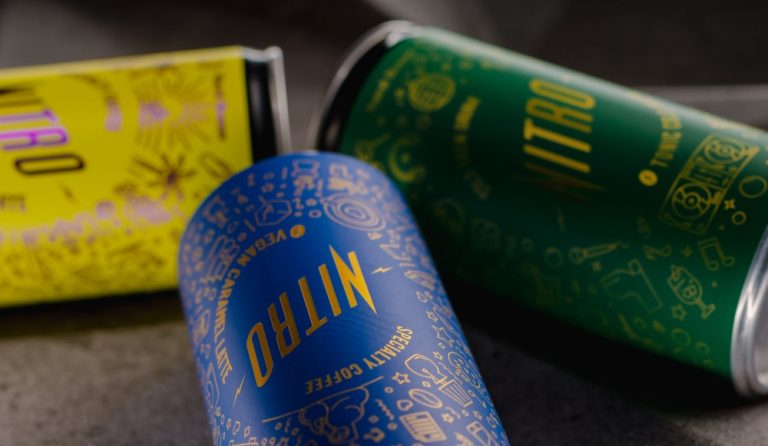
The brand launched two products in 2024: a black nitro cold brew and an oat latte, both based on what customers already ordered at the bar. Wakuli Coffee expanded the range to four SKUs in 2025, adding a cinnamon oat latte and a grapefruit cold brew spritz. Both drinks had already proven themselves over the counter.
That sequence came from careful calibration. “Having our own bars is a real advantage here,” Gabriel says. “We can test a drink with real customers long before it becomes a can.” Rather than guessing about demand, Wakuli Coffee used its own cafés as a live testing environment. Consumer behaviour shaped the product roadmap before the team committed to canning.
The coffee in every can is a washed arabica from Mexico, from Wakuli Coffee’s partnership with Union San Pedro, roasted specifically for cold brew. Traceability runs down to the producer partnership, and it sits in the product from the start. That approach matches how Wakuli Coffee operates across its entire range.
The hardest part, Gabriel admits, was translating the bar experience into a canned format with the required stability and shelf life.”Getting the taste of a beverage prepared in our bars in a can. Getting an experience as close as possible that survives the canning and pasteurisation process.” It took several rounds of iteration to get there. “Hardtank is really good at it and helped us go through several iterations of testing and formulation.”

Leaving compliance while maintaining creative control
Wakuli Coffee keeps control of the recipe and label, while Hardtank handles canning, pasteurisation, and the legal and nutritional requirements.
Gabriel is clear about why the partnership works, and it comes down to the division of labour.
“We stay fully in control of the recipe, design of the label. And Hardtank brings the expertise on canning, pasteurisation, and the legal and nutritional side of putting a beverage on the market. That division of labour has worked really well. We could develop the product our way, and the quality of what comes out is something we are genuinely happy to put our name on.”
Hardtank’s custom formula service works on exactly this model. Roasters and beverage brands keep ownership of their recipe and brand identity, while Hardtank works with them to adapt the formulation to the production process and manages the technical and regulatory requirements. It means brands like Wakuli Coffee can move from concept to shelf without building specialist capability in-house.
Wakuli Coffee’s tip for other roasters
Treat the can as an extension of a drink customers already order, and keep the recipe and the coffee in your own hands.
Gabriel’s advice to roasters considering their first RTD follows Wakuli Coffee’s own experience. “Do not treat the can as a separate product; treat it as an extension of something your customers already ask for, because then you are not guessing about demand.”
Beyond product strategy, he points to where a roaster’s identity lives. “Keep control of the recipe and the coffee; that is where your identity sits. And pick a partner who is comfortable with you doing exactly that, rather than one who wants to hand you a finished formulation.”
That is one of the key differences between a custom RTD and a private label product with your logo on it: the level of control you retain over the coffee, recipe, and final product. For a brand built on sourcing transparency and recipe integrity, handing that over would have undermined its position.
On the working relationship, Gabriel remarks: “The relationship itself has been easy, which is not something to take for granted in this kind of cooperation. We appreciate the way the team works with us and we are glad to say so publicly.”

Wakuli Coffee: Key takeaways
- Wakuli Coffee built its RTD range from its most popular bar drinks, using its own cafés as a testing ground before production.
- The partnership leaves Wakuli Coffee in full control of recipe and sourcing, while Hardtank handles canning, pasteurisation, and compliance.
- Gabriel advises roasters to extend a drink customers already want, keep the recipe, and choose a partner comfortable with that.
Ready to launch your own custom RTD? Learn more about Hardtank’s custom formula service, or get in touch with the team to talk through your brief.
Wakuli Coffee: FAQ
How did Wakuli Coffee decide what to put in its RTD range?
Wakuli Coffee started with its two most popular bar drinks, a black nitro cold brew and an oat latte, and turned those into its first RTD products in 2024. Owning coffee bars let the team test drinks on real customers first. Two further products followed in 2025 the same way.
Why did Wakuli Coffee work with Hardtank rather than produce RTDs in-house?
Wakuli Coffee wanted to keep the coffee and recipe entirely its own without building canning and compliance capability internally. Hardtank’s custom formula service let the brand keep creative and sourcing control while Hardtank managed production, pasteurisation, and the legal and nutritional requirements.
What is Hardtank’s custom formula service?
The custom formula service lets beverage brands and roasters develop their own RTD formulation, which Hardtank then produces, cans, and manages through compliance and quality control. Brands keep ownership of the recipe. It suits brands that want a fully custom product without building production infrastructure.
Want to learn more about Hardtank’s RTD services?
- Launch a custom RTD: learn more about our custom formula service.
- Explore private label options: browse our RTD services here.
- Speak to the team: get in touch here.